



How Legal Strategies Drive Effective Debt Recovery for Lenders in India
Every financial institution, whether a bank, NBFC, or fintech lender, must be deeply familiar with the debt recovery laws that govern their operations. Legal debt recovery strategies are not just about enforcing repayment but about using structured legal tools to recover dues efficiently while maintaining compliance with the Reserve Bank of India’s (RBI) and SARFAESI Act provisions.
Why Legal Preparedness Matters in Debt Recovery
Negotiations with borrowers often break down, leaving litigation as the only viable route. However, rushing to court without the right legal strategy can be counterproductive, increasing costs and timelines. That’s why legal preparedness, knowing which strategies to apply, when to escalate, and how to communicate, sets efficient lenders apart.
How Timely Legal Intervention Helps Prevent Defaults
Early legal action signals credibility and seriousness to defaulters. Sending a legal demand notice or notice of default is often the first step.
The notice outlines dues, references the original contract, and cites potential legal consequences if payment is not made. Borrowers faced with such clarity often prefer settlement, avoiding prolonged litigation.
If negotiation and restructuring attempts fail, lenders can initiate legal proceedings supported by a thorough documentation trail.
How Litigation Works in Debt Recovery
Litigation is often perceived as the last resort but remains one of the most robust methods for debt enforcement.
To initiate proceedings effectively:
1. Involve both in-house legal teams and external counsels specialized in loan recovery
2. Collate all documents, loan agreements, notices, repayment schedules, and borrower communication
3. Assign a single executive responsible for coordinating across departments
A court order can compel compliance, enabling structured repayment or asset seizure in case of default.
What Makes Debt Recovery Tribunals (DRTs) More Effective
India’s Debt Recovery Tribunals (DRTs) were established to expedite cases under the Recovery of Debts Due to Banks and Financial Institutions Act.
Compared to civil courts, DRTs provide:
- Shorter timelines for hearing debt recovery applications
- Specialized judges and advocates experienced in recovery law
- Higher enforcement rate for non-performing assets (NPAs)
When insolvency or bankruptcy proceedings are necessary, lenders can approach the National Company Law Tribunal (NCLT) for resolution under the Insolvency and Bankruptcy Code (IBC).
Why Asset Reconstruction Companies (ARCs) Are Sometimes the Right Option
In high-NPA portfolios, lenders can transfer bad loans to Asset Reconstruction Companies (ARCs) to clean their balance sheets.
ARCs have the required expertise and legal muscle to enforce collection through restructuring, settlement, or liquidation. This approach allows lenders to recover at least partial dues without engaging directly in long legal battles.
How Enforcement of Collateral Protects Lenders
For secured loans, the collateral gives lenders an added layer of legal leverage. Under SARFAESI, lenders can enforce security interest without court intervention in certain cases, provided due process is followed.
However, lenders must approach enforcement ethically, ensuring they maintain clean documentation and fair dealing with the borrower, as these factors influence judicial outcomes.
Key Benefits of Strong Legal Debt Recovery Strategies
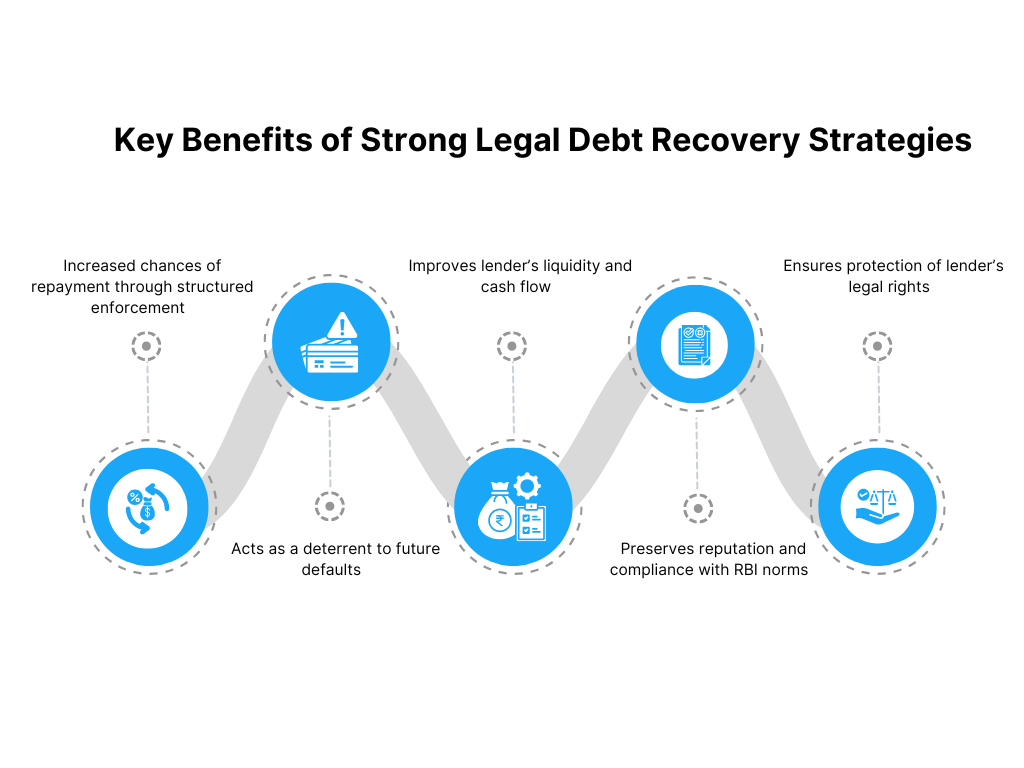
- Increased chances of repayment through structured enforcement
- Acts as a deterrent to future defaults
- Improves lender’s liquidity and cash flow
- Preserves reputation and compliance with RBI norms
- Ensures protection of lender’s legal rights
Best Practices: How to Implement Legal Strategies Effectively
- Maintain comprehensive borrower documentation,loan files, payment history, agreements
- Act promptly when a loan turns delinquent; time is crucial in recovery
- Send legally reviewed demand notices before filing a case
- Seek professional guidance from experienced legal service providers
- Monitor proceedings through a centralized legal case management system
What To Consider When Choosing a Debt Recovery Approach
When selecting the best way to recover outstanding debts, lenders must weigh several legal and strategic options. Each approach varies in suitability depending on the debt size, borrower profile, compliance requirements, and time sensitivity.
How Lok Adalat and Permanent Lok Adalat Offer Efficient Resolution
Lok Adalat, known as “People’s Court,” is a unique mechanism set up under the Legal Services Authorities Act specifically for amicable, out-of-court settlements of disputes—including loan and recovery cases. Lok Adalats are especially suited for fast, cost-effective recovery of small and medium-sized debts from individuals and MSMEs, such as personal loans, credit card dues, and smaller business loans.
Permanent Lok Adalat is a special type empowered to resolve disputes related to public utility services and banking, up to ₹1 crore. If parties fail to reach a settlement through conciliation, the Permanent Lok Adalat can adjudicate the case. Its awards are final, binding, and enforceable like a court decree, with no appeal allowed.
Key benefits:
- Faster, stress-free resolutions (often within one or two hearings)
- No court fees or complicated litigation
- Legally binding settlements
- RBI encourages use of Lok Adalat for loans under ₹10 lakh to reduce court pendency and support inclusive financial practices.
Why Consider Other Debt Recovery Avenues
Besides Lok Adalat, lenders can choose from routes such as:
- Negotiation and Restructuring: Initiate dialogue with borrowers to renegotiate terms, settle for a lump sum, or restructure the repayment schedule, effective for both retail and corporate loans.
- Debt Recovery Tribunals (DRTs): Specialized for faster settlement of larger, secured or NPA accounts, including cases under the Recovery of Debts Due to Banks and Financial Institutions Act (RDDBFI).
- SARFAESI Proceedings: For secured loans, lenders can enforce mortgage assets without court intervention, streamlining collateral recovery and minimizing loss.
- Insolvency Proceedings: Under the Insolvency and Bankruptcy Code (IBC), especially suited for high-value or distressed loans involving businesses.
- Asset Reconstruction Companies (ARCs): For bulk NPA resolution, lenders may sell bad loans to ARCs for immediate balance sheet relief.
- Traditional Civil Litigation: For complex or contested cases where other avenues are exhausted.
What Factors Should Lenders Assess?
- Size and type of debt, smaller, unsecured loans are best suited to Lok Adalat, while high-ticket or secured loans may require DRT/SARFAESI/IBC action.
- Urgency and desired timeline, Lok Adalats and negotiation are quickest, while litigation is slowest.
- Borrower’s situation, Settlement and mediation may suit borrowers facing temporary financial hardship.
- Legal compliance, Each avenue has regulatory mandates (e.g., RBI and SARFAESI compliance).
- Cost implications, Lok Adalat and mediation are low-cost; litigation is expensive and slow.
By leveraging Legodesk’s platform, lenders can streamline arbitration, track ongoing cases, and automate workflows for Lok Adalat, DRT, and other legal avenues, maximizing both efficiency and compliance at every step.
How Legal Tech Platforms Like Legodesk Simplify Debt Recovery
Legodesk empowers lenders by automating and streamlining every stage of legal recovery:
- Automated generation and dispatch of legal notices
- Integrated case management system for DRT, NCLT, and arbitration tracking
- Contact and communication management
- Real-time coordination via Feet-on-Street app for field agents
- Compliance-ready reports for NBFCs and banks
By combining automation with legal intelligence, Legodesk reduces manual workload, enhances traceability, and ensures lenders never miss a compliance step in the recovery process.
Overcoming Common Challenges in Legal Debt Recovery
- Inadequate documentation: Use digital storage for all loan and notice documents.
- Limited debtor Integrate credit bureau information and KYC records.
- Resistance to repayment: Use legal notices and negotiation together.
- Complex legal processes: Partner with legal tech platforms that automate case tracking.
- Enforcement delays: Leverage courts, tribunals, and SARFAESI tools strategically.
Why Partnering with Legal Professionals Adds Value
A good legal team ensures compliance with RBI and IBC norms, guides on the proper sequence of legal escalation, and represents the lender professionally before judicial bodies. Partnering with firms using digital tools such as Legodesk ensures better visibility and quicker outcomes in debt enforcement. Moreover, with its partner network, Legodesk can help you reduce the grunt work to ensure results are fast and efficient.
Frequently Asked Questions (FAQs)
1. What is the best legal strategy for debt recovery in India?
Negotiation and restructuring should be the first steps. If unresolved, escalation to DRT or civil court proceedings supported by proper documentation is most effective.
2. How can NBFCs and lenders speed up debt recovery legally?
By adopting digital case management tools, automating notice issuance, and engaging specialized debt recovery lawyers. Legodesk’s automation reduces turnaround time significantly.
3. When should lenders involve legal professionals in the recovery process?
Legal support should be sought immediately after default notices are sent or when borrowers skip multiple repayment cycles.
4. What documents are needed before initiating legal debt recovery?
Loan agreements, repayment records, KYC, default notices, and borrower communications are critical. Digitizing them helps in quick filing and case tracking.
5. How does Legodesk help with DRT or NCLT case tracking?
Legodesk integrates with court databases, helping lenders monitor each case’s progress, generate reports, and automate follow-ups for faster resolution.
6. Why is legal tech important for modern debt recovery?
It reduces manual errors, speeds up compliance workflows, and provides a data-backed approach to recovery strategy, essential for lenders handling high NPA volumes.
